
Slicing, Matching and Grading
Veneers Slicing Methods
Rotary
The entire log is peeled and can yield full sheets of veneer. Grain pattern is broad with no plain or quarter sliced appearance. Rotary is the only cutting method that is capable of producing whole piece faces.

Selection Process
Selecting the right wood for veneer is a careful process that requires experience and expertise. Quality starts with evaluating each log individually—considering straightness, size, color, surface defects, and other key factors—to ensure the best possible outcome in the final panel.
Rotary Benefits
Produces a broad, variegated pattern
Yields the most veneer per log
Full-sized whole piece faces
Less expensive than sliced veneer
Used in majority stock panels produced in North America
Plain Sliced
Plain Sliced Veneer (Flat Cut) is the most common and cost-effective method for cutting veneers. The log is sliced parallel to a line through its center, producing sheets that follow the growth rings. This technique reveals a natural and attractive grain pattern, typically a combination of “Cathedral” arches in the center of the sheet and Straight grain along the edges.

Plain Sliced Benefits
Most common slicing method
Veneer cut along the growth rings
Combines classic cathedral and straight grain patterns
High yield makes plain slicing the most affordable method
Quarter Sliced
Creates a striped pattern—straight in some species, more varied in others. In oak, slicing through medullary rays produces a distinctive flake pattern. Most other species resemble the look of rift cut.

Quarter Sliced Benefits
Cut is perpendicular to the growth rings
Produces a straight grain appearance
May produce ray flake in red and white oak
Produces narrower components than plain slicing
Quarter slicing yields less veneer per log, making it more expensive than plain slicing
Rift Slicing
A quarter log is mounted on a stay log lathe and rotated against the blade at a set angle to produce a straight, uniform rift grain. The result is a tight, linear pattern with minimal variation, free from the “flake” often seen in quarter-sliced wood. This method is ideal for oak and other species where a clean, consistent grain is desired.

Rift Sliced Benefits
Exceptionally straight grain – produces a uniform, linear pattern
No “flake” figure – avoids the ray fleck common in quarter-sliced oak
Minimal grain variation – consistent appearance across boards
High-end aesthetic – often preferred for fine furniture, cabinetry, and architectural millwork
Strong dimensional stability – reduces warping and movement compared to plain slicing
Matching Process
Book | Slip | Random | Pleasing | Plank
All spliced plywood faces are made by joining multiple veneer leaves to create a complete panel face. Common matching methods include book, slip, random (or mismatch), pleasing, and plank match—each producing its own distinct pattern and visual effect. In certain cases, the Standard defines the required match type based on species and grade.
Book Match
The most common match: alternating veneer leaves are flipped to mirror each other, like pages in a book.
Visual effect: Veneer joints align to form a symmetrical pattern with continuous grain. Distinct features may rise or fall across the panel.

Slip Match
Adjacent veneer leaves are laid out in order without flipping, keeping the same side of each leaf visible.
Visual effect: The pattern repeats, but grain doesn’t align at the joints. Color appears more uniform due to consistent light reflection. Joints are less visible with straight grain; slight slanting can occur if the grain isn’t perfectly vertical.

Random Match
Visual effect: No consistent pattern or grain alignment should be expected across the face.

Pleasing Match
Veneer leaves are selected and matched based on similar color.
Visual effect: Offers a generally uniform appearance with no stark color contrasts at the joints. Grain alignment may vary.
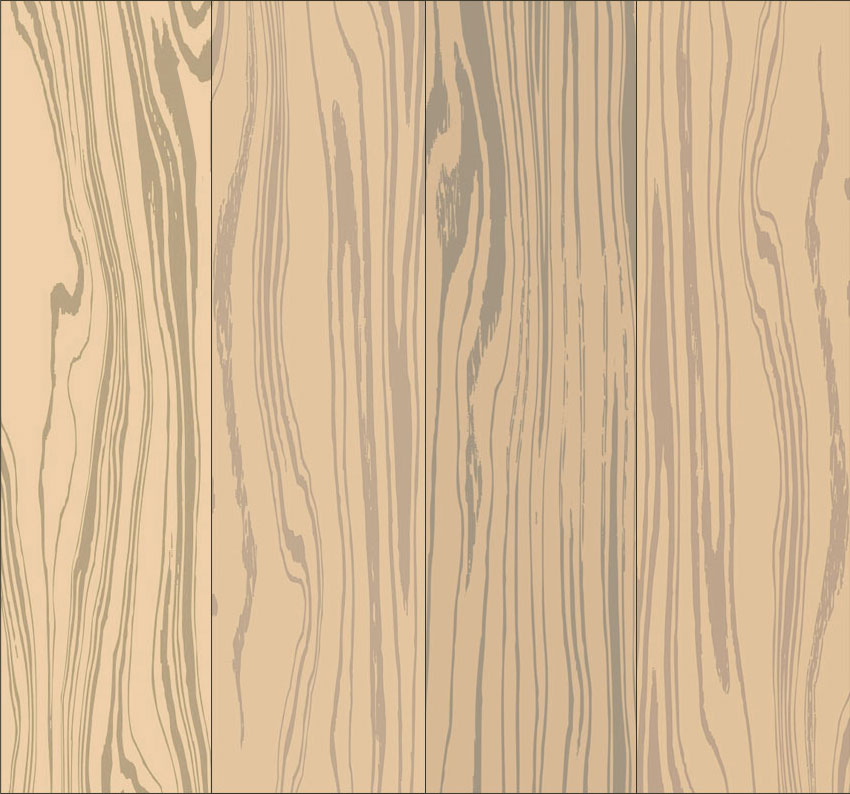
Plank Match
Veneer leaves of the same species are combined without matching color or grain, creating natural variations, contrasts, and patterns. A uniform or pleasing appearance is not required but Even Tone Color can be specified when color uniformity is desired.
Visual effect: Creates a casual or rustic look, with panel components varying in width.

Grading Process
Hardwood Plywood Face & Back Grades
The following tables offer a general overview of face and back grades for hardwood plywood, as defined in the current Voluntary Standard. For a full understanding of each grade’s features and characteristics, please refer to the complete Standard.
Face Grade Applications
AA
A high-end face grade intended for exclusive applications like architectural paneling, interiors, case goods, fine furniture and premium cabinetry.
A
Where AA is not required but excellent appearance is still important.
B
Where the natural characteristics are desirable or when a better value is preferred.
C
Allows unlimited color variation and more natural features. Ideal for cost-effective applications.
D and E
Offer sound surfaces with unlimited color variation and permit repaired knots of increasing sizes. Suitable for concealed applications and paint grade applications.
Back Grade Descriptions
1 & 2
Grades 1 and 2 have sound surfaces with all openings repaired, except small vertical wormholes.
3
Grade 3 allows larger and more defects than Grade 2, putty repaired and sanded smooth.
4
Grade 4 permits larger and more defects than Grade 3 with no putty repair. Often referred to a “Mill Option Back” or “Reject Back”.
Available for Use
Another key factor is the quantity of material available in each grade for use. The accompanying graphic shows that a typical rotary-cut hardwood log yields mostly B and C grade material, with only a small portion qualifying as AA grade.

As demand on hardwood resources increases, it’s more important than ever to use them efficiently. Veneered hardwood plywood panels make excellent use of this resource, but it’s crucial to choose the right grade. Typically, rotary-cut hardwood logs yield large amounts of B and C grade material but only a small portion of AA grade.
The following graphic illustrates that as you move down the grade scale, both the overlap between grades and the range of acceptable appearances within each grade increase.

Automatically requesting A or AA panels as “the best” may not always be the most practical choice. When selecting panels, consider whether a B or C grade panel might meet your needs. Choosing a lower grade can offer better value while helping conserve hardwood resources.
Wholesale Supplier · Where to Buy
Mt. Baker Products is a trusted wholesale supplier specializing in high-quality decorative panels sold throughout our distribution network. We have a strong focus on quality, consistency, versatility, and industry-leading lead times to support the needs of construction and design professionals across North America.
We work with our distribution partners and end users to identify the right product at the best value.
Wholesale Distributors
Looking for top-tier plywood panels from a trusted local source? Perfect for professional woodworkers.
North America
We work with distribution partners and end users across North America to identify the right product at the best value.
Call Us
We’d love to assist you with your woodworking needs. Please give us a call to chat with our sales staff.

FSC Certified

LEED Qualified

TSCA Certified
Exempt Status

CARB Certified
Exempt Status
